
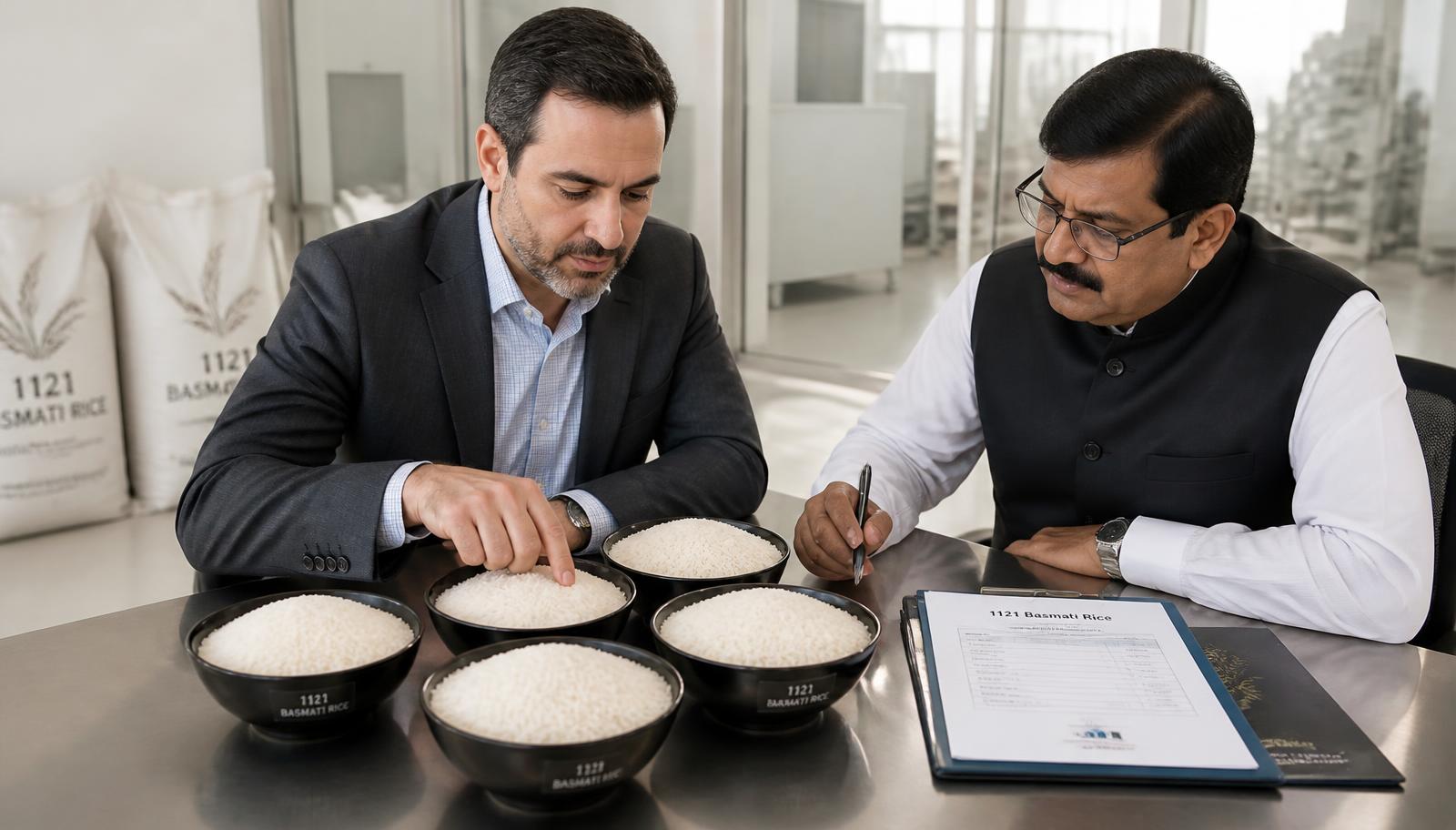
A supplier may offer an attractive quotation, but that alone does not tell you whether the rice will meet the agreed specification from one shipment to the next. A stronger approach is to evaluate the complete supply relationship: product specifications, quality controls, samples, documentation, communication, packaging and the supplier's ability to meet agreed requirements consistently.
This guide explains the key areas buyers should review before choosing a Basmati rice supplier.
What Makes a Basmati Rice Supplier Reliable?
A reliable supplier should be able to clearly explain what they are offering and how the product is controlled.
Before discussing price, confirm the exact product specification. This may include the rice variety, processing type, grain characteristics, broken percentage, moisture requirement, packaging format and any quality parameters relevant to your purchase.
Good suppliers communicate these details clearly instead of relying only on phrases such as "premium quality" or "best rice."
For B2B purchasing, clarity is important because the specification becomes the reference point for sampling, production, inspection and shipment approval.
Start With the Rice Specification
The first step is to define what you actually need.
For Basmati rice, buyers may need to distinguish between varieties, processing types and grades. Terms such as 1121, 1509, Steam and Sella describe different product characteristics or processing approaches and should not be treated as interchangeable labels.
A useful specification should cover:
- Variety
- Processing type
- Grain characteristics
- Broken grain tolerance
- Moisture requirement
- Purity and foreign-material requirements
- Appearance
- Packaging
- Quantity
- Inspection or testing requirements
The more precise the specification, the easier it becomes to compare suppliers on a like-for-like basis.
Evaluate More Than Grain Appearance
Visual appearance is important, but it is only one part of quality.
A professional buyer should consider whether the supplier can consistently control measurable characteristics such as moisture, broken grains, purity and grain uniformity.
For internationally traded milled rice, Codex provides internationally recognized quality provisions for rice, including limits relating to moisture and extraneous matter. Buyer specifications and destination requirements may be more specific, so contractual requirements should always be clearly defined.
This is why a reliable supplier should be comfortable discussing specifications and quality documentation rather than relying entirely on visual claims.
Request a Representative Sample
A sample is one of the most useful tools in supplier evaluation.
The sample should represent the product you are actually considering purchasing. Compare:
- Grain appearance
- Uniformity
- Aroma
- Broken grains
- Cooking performance
- Cleanliness
- Colour appropriate to the agreed processing type
For a serious B2B purchase, the sample should not be treated as a marketing showcase alone. The important question is whether the supplier can reproduce the same specification consistently at commercial scale.
Before placing an order, clarify how the approved sample relates to the final shipment specification.
Check Quality Control and Testing
Ask how the supplier verifies the rice before dispatch.
Depending on the agreed specification, quality checks may include moisture measurement, grain-size analysis, broken-kernel assessment, visual inspection and laboratory testing for relevant safety parameters.
A Certificate of Analysis can be useful when it accurately reflects the product being supplied.
The key is not simply to ask, "Do you test the rice?"
Ask instead:
What is tested?
When is it tested?
Against which specification?
Who performs the testing?
Can the relevant records or certificate be provided?
The answers give you a much clearer picture of the supplier's quality-control process.
Review Processing and Handling
Rice quality is influenced by more than the variety itself.
Milling, sorting, grading, handling, storage and packing all contribute to the final product.
A supplier should therefore be able to explain its production and quality process clearly enough for a buyer to understand how the agreed specification is maintained.
Look for a documented process rather than vague statements such as "modern technology" or "international quality."
The best evaluation is evidence-based: samples, specifications, test results, inspection arrangements and documented processes.
Documentation Matters
For commercial shipments, documentation is part of supplier reliability.
Depending on the transaction and destination, buyers may need commercial documents, packing information, certificates or product-specific documentation.
The exact documentation should be agreed before shipment rather than discovered after the cargo is ready.
A reliable supplier should communicate document requirements clearly and coordinate them with the shipment process.
Review Packaging Carefully
Packaging protects the rice during handling, storage and transportation.
The appropriate packaging depends on the product, quantity, distribution model and buyer requirements.
Before confirming an order, establish:
- Bag type
- Net weight
- Packaging material
- Printing requirements
- Marking and labelling requirements
- Palletization, if required
- Loading and handling expectations
Packaging should match the commercial specification rather than being treated as an afterthought.
Evaluate Communication
Communication is an important indicator of operational reliability.
Pay attention to whether the supplier answers questions precisely, provides requested documents, explains product differences and flags issues before they become problems.
Fast replies are useful, but clear replies are more important.
A supplier who communicates accurately during the quotation and sample stage is easier to work with once an order is placed.
Compare Total Value, Not Just Price
The lowest quotation is not always the lowest-cost option.
A slightly cheaper shipment may become more expensive if inconsistent quality leads to customer complaints, additional inspection, repacking, delays or rejected product.
When comparing suppliers, consider the total commercial value:
- Product consistency
- Agreed specifications
- Testing and inspection
- Packaging
- Documentation
- Communication
- Shipment reliability
- Ability to maintain the agreed quality
This creates a more realistic comparison than price alone.
Think About Long-Term Consistency
A strong supplier relationship is built around repeatable specifications.
For recurring purchases, discuss how the supplier will maintain consistency between shipments.
Ask how changes in raw material availability, processing conditions or packaging will be handled.
Your objective is not simply to find good rice once. It is to establish a supply relationship in which the agreed product can be reproduced reliably over time.
A Practical Supplier Evaluation Checklist
Before choosing a supplier, confirm that you can answer "yes" to most of these questions:
| Area | What to verify |
|---|---|
| Product | Exact variety and processing type are clearly defined |
| Specification | Quality parameters are documented |
| Sample | A representative sample has been reviewed |
| Testing | Relevant quality checks are available |
| Documentation | Required shipment documents are understood |
| Packaging | Packaging matches the intended use |
| Communication | Questions receive clear answers |
| Consistency | Supplier can explain how repeatability is controlled |
| Commercial terms | Order and payment terms are clearly documented |
| Inspection | Inspection arrangements are understood |